

Deciding to remove breast implants without replacing them is a meaningful decision. For some women, it brings relief. For others, it brings mixed feelings - hope, uncertainty, grief, freedom, and a long list of practical questions.
The most common question is direct and completely reasonable:
There is no single answer that fits everyone. Your natural breast tissue, skin elasticity, implant size, implant position, how long the implants have been in place, pregnancies, weight changes, and normal aging all matter. Even with those variables, a realistic picture is possible. The goal is clarity - not guesswork.
Dr. Michael Baumholtz, a dual board-certified plastic surgeon in San Antonio, approaches implant removal with four anchors:
- Clarity
- Safety
- Realistic expectations
- Options that fit the patient - not a trend
This guide explains what typically changes after implant removal, what options exist, and how to choose a plan that makes sense for your body and your life.
Ready for Surgery? Take Dr Baumholtz Breast Surgery Quiz
There is no single “correct” reason to remove implants. The right reason is the one that fits your life now.
Common reasons include:
- Wanting to step off the cycle of future implant replacement
- Concern about rupture or implant aging
- Capsular contracture (tight scar tissue around the implant)
- A desire for a softer, more natural upper chest
- Chest tightness, heaviness, or discomfort with activity
- Changes after pregnancy, weight shifts, or aging
- A shift in identity or lifestyle
Some women simply feel done. That is a valid reason.
If the decision feels emotional, that does not make it wrong. It makes it personal.
Video: Voluntary Removal Of Textured Implants From Allergan - BIA - ALCL
What Typically Changes After Implant Removal
Implants add three things:
- Volume – overall size
- Projection – how far the breast sits forward
- Upper pole fullness – the round fullness in the upper chest
When an implant is removed, those decrease.
Most women notice:
- Smaller breast size
- Softer upper chest
- Less cleavage
- Possible skin laxity if the skin was stretched for years
- A breast that may sit lower as tissues settle
The Timeline Matters
Early swelling can be misleading.
- Weeks 0–6: swelling, shifting, temporary asymmetry
- Weeks 6–12: tissues begin to settle
- Months 3–6: the baseline shape becomes clear
- Up to 12 months: scars and subtle tissue changes continue to mature
Making permanent decisions during temporary swelling often leads to regret. Patience improves accuracy.
The Planning Framework: Size vs Position vs Contour
Clear planning starts by separating the issue.
✓ Size
How large do you want your breast to be?
✓ Position
Where do you want the nipple and breast mound to sit?
✓ Contour
Are there dents, hollows, thin areas, or ripples that need smoothing?
Separating these three concerns keeps the plan rational and steady.
- If the main issue is position, a lift is the most direct tool.
- If the main issue is contour, staged refinement may help later.
- If the main issue is size, non-implant options have limits that must be discussed honestly.
Capsule Management and a Clear Word About “En Bloc”
Every implant forms a capsule - a layer of scar tissue around the implant. Some capsules are thin and soft. Some become thick, tight, painful, or distorted.
The term “en bloc” is often misunderstood online.
Medically, en bloc removal refers to removal of a tumor and surrounding tissue in one piece in cancer surgery. It is not a routine requirement for standard elective implant removal.
In aesthetic explant surgery, the decision may involve:
- Leaving a thin capsule in place
- Partial capsulectomy
- Total capsulectomy
The correct choice depends on symptoms, implant history, imaging when appropriate, and safety considerations specific to you.
The priority is a clean, safe operation and healthy healing - not internet terminology.
A Key Clarification About Fat Grafting and ALLOCLAE
Fat-based options can be helpful, but they are refinement tools, not implant replacements.
After implant removal, there is a temporary cavity where the implant sat. Fat cells need a healthy, well-vascularized tissue bed to survive. Placing fat immediately into a fresh, unsupported space reduces predictability.
For that reason, Dr. Baumholtz typically stages fat grafting or structural fat products such as ALLOCLAE after tissues have healed.
Staging is not delay.
Staging is precision.
Realistic goals of fat-based refinement:
- Soften thin areas
- Smooth contour irregularities
- Improve mild asymmetry
- Add subtle, natural softness
Fat grafting does not recreate implant-level projection.
The Three Main Options After Implant Removal
These are tools. Some women choose one. Some choose more than one in stages.
✓ Option 1: Implant Removal Only - Then Time
This is the simplest approach.
Who It Fits
- Women who want the least surgery
- Women who feel emotionally done
- Women who want to see their true baseline before adding scars
What to Expect
- Smaller size
- Softer upper chest
- Natural settling over 6–12 weeks
- A stable baseline by 3–6 months
What Support Bras Can and Cannot Do
Support bras:
- Improve comfort
- Help manage swelling
- Provide gentle shaping during healing
They do not:
- Lift the nipple permanently
- Remove excess skin
- Recreate upper pole fullness
Allowing time prevents rushed decisions.
✓ Option 2: Implant Removal With Breast Lift (Mastopexy)
If removal addresses volume, a lift addresses position.
A breast lift:
- Tightens the skin envelope
- Elevates the nipple
- Reshapes and compacts natural tissue
- Improves clothing fit
It does not recreate implant-style upper fullness.
When a Lift Makes Sense
- Nipple sits at or below the inframammary fold
- Nipple points downward
- Skin is stretched
- Bras and clothing fit poorly due to low position
Scar Patterns
Depending on anatomy, options may include:
- Periareolar (around the areola)
- Vertical (lollipop)
- Wise pattern (anchor)
The tradeoff is shape for scars. That tradeoff is discussed clearly before surgery.
Recovery
- Walking begins immediately
- Heavy lifting resumes after clearance
- Support bra worn during healing
- Scar care includes silicone therapy and sun protection
Compact reshaping can make the breast appear slightly smaller even when no tissue is removed. That effect is explained beforehand.
✓ Option 3: Implant Removal With Staged Refinement
After healing, refinement may include:
- Autologous fat grafting (your own fat)
- Structural fat products such as ALLOCLAE
These are best for:
- Small contour irregularities
- Thin upper chest transitions
- Mild asymmetry
They are not designed for major size change.
Some resorption of fat is expected. Predictability improves with conservative, layered placement and realistic goals.
Breast Revision Before and After Photos
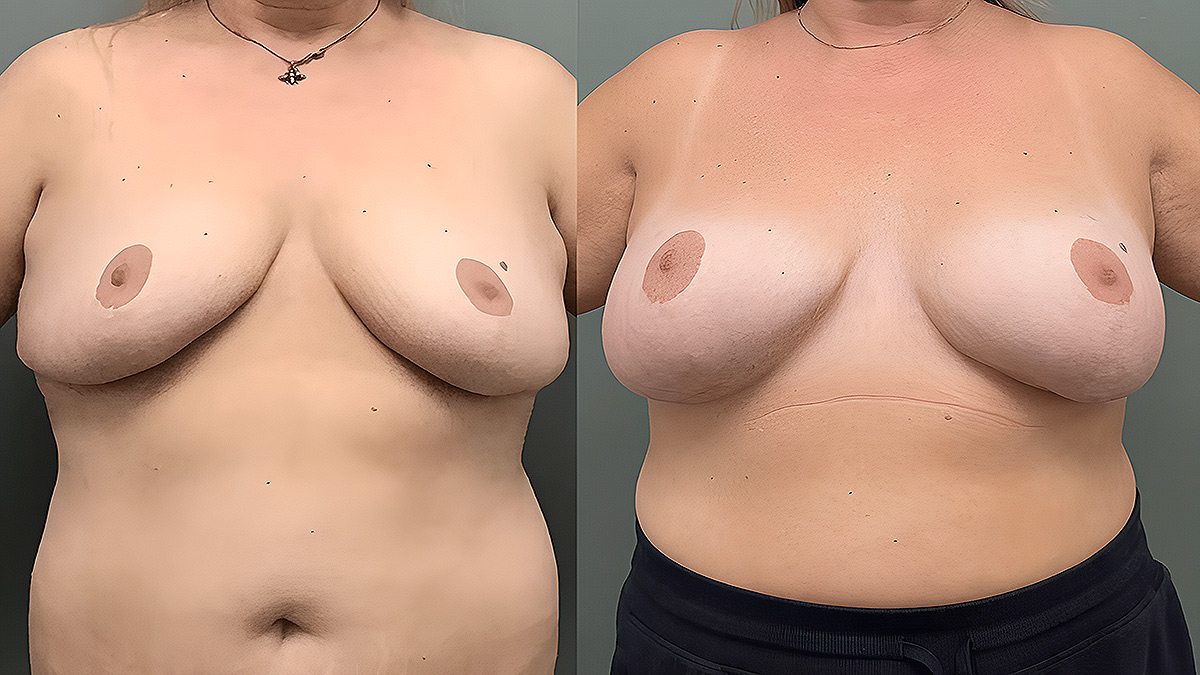
Visit Breast Revision Gallery for More Before and After Photos
Common Combinations
- Removal only – simplest path
- Removal + lift – improves position
- Removal + lift + staged refinement – position first, contour second
Staging protects blood supply and improves predictability.
Risks of Implant Removal and Lift
All surgery carries risks. These may include:
- Bleeding
- Infection
- Delayed wound healing
- Changes in nipple sensation
- Asymmetry
- Recurrent laxity over time
- Visible scars
- Need for revision
Capsule removal may increase operative time and complexity depending on anatomy.
A detailed discussion is part of consultation. Decisions are made case by case.
The Emotional Timeline
Physical healing is expected. Emotional adjustment is often underestimated.
Common reactions include:
- Relief
- Lightness
- Confidence
- Uncertainty
- Temporary sadness
Adjustment is normal. Scars can make the change feel real. Position improvement often brings comfort. Both reactions can coexist.
What a Consultation Should Clarify
A proper consultation should leave you calm and informed.
You should understand:
- How much natural tissue remains
- Skin elasticity
- Nipple position relative to the fold
- Whether a lift would improve proportion
- Whether staging improves safety in your case
- Realistic expectations about size and upper pole fullness
Standardized photos and objective measurements help align goals with anatomy.
Cost Transparency
Baumholtz Plastic Surgery is a self-pay practice.
Costs vary based on:
- Operating time
- Capsule management
- Whether a lift is added
- Whether staged refinement is planned
Fees include surgeon, anesthesia, and facility components.
Value is not the lowest price.
Value is a safe plan, predictable execution, and thoughtful follow-up.
Frequently Asked Questions
Will I look deflated after removing implants?
Some women do, especially after large or long-standing implants. Others look natural and balanced. It depends on tissue quality and skin elasticity.
Can I remove implants now and decide on a lift later?
Yes. Many women remove implants first and reassess at 3–6 months.
Will I still have cleavage?
Upper pole fullness decreases. A lift improves position but does not recreate implant-style projection.
Is fat grafting guaranteed?
No. Some resorption is expected. Results are modest and not guaranteed.
Do I need total capsulectomy?
Not routinely. The decision is individualized.
When can I exercise?
Light walking immediately. Strenuous lifting resumes after clearance.
How long until I see final results?
Baseline shape is typically clear by 3–6 months. Scar maturation continues up to one year.
Medical References
- Immediate Autologous Fat Transfer into the Breast for Volume Restoration After Implant Removal - Aesthetic Plastic Surgery - https://pubmed.ncbi.nlm.nih.gov/40877599/
- Breast Explantation With Simultaneous Mastopexy and Autologous Fat Grafting - Annals of Plastic Surgery - https://pubmed.ncbi.nlm.nih.gov/36911998/
- Fat Grafting and Auto-Augmentation Mastopexy After Breast Implant Removal: Technique and Evaluation of Outcomes Using BREAST-Q - Aesthetic Surgery Journal - https://pubmed.ncbi.nlm.nih.gov/33300983/
- Breast Implant Removal-Only: The Role of Targeted Compression - Aesthetic Surgery Journal - https://pubmed.ncbi.nlm.nih.gov/39043947/
- Fat Grafting to the Breast for Aesthetic Indications - Aesthetic Surgery Journal - https://pubmed.ncbi.nlm.nih.gov/37985505/
- One-Stage Mastopexy-Lipofilling after Implant Removal - Aesthetic Plastic Surgery - https://pubmed.ncbi.nlm.nih.gov/35064339/
- Breast Augmentation in Body Contouring Using Autologous Stem Cell-Enriched Fat Grafting - Journal of Clinical Medicine - https://pubmed.ncbi.nlm.nih.gov/40869433/
Closing
Breast implant removal without replacement is not about trends. It is about alignment - anatomy, comfort, and where you are in your life.
The best plan is the one that:
- Matches your goals
- Respects your biology
- Acknowledges tradeoffs clearly
- Prioritizes safety
If you are considering breast implant removal in San Antonio, schedule a private consultation with Dr. Michael Baumholtz. The conversation is calm, direct, and grounded in objective measurements.
This guide is educational. It does not replace an in-person consultation.
All procedures carry risk. Individual results vary. Decisions are made case by case after examination and discussion.
Further Reading
- Read more about Breast Augmentation
- Read more about Breast Reduction
- Read more about Capsular Contracture
- Read Dr Baumholtz's Blog on Do Breast Implants Need To Be Replaced Every 10 Years?
- Read Dr Baumholtz's Blog on What’s the Best Breast Implant Placement? Submuscular vs Subglandular vs Dual Plane
- Read Dr Baumholtz's Blog on Fat Grafting or Implants: Which Is Best for You?
- Read Dr Baumholtz's Blog on Do I Need a Breast Lift With My Implants?