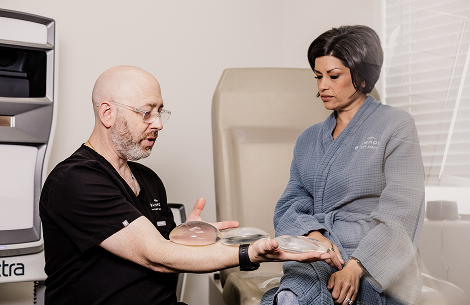


A structured, functional, and balanced approach to rhinoplasty in San Antonio, Texas
Most people do not wake up one morning and suddenly decide to change their nose.
The thought usually builds over time.
It might start with a side-profile photo that feels “off.” It might show up when smiling in the mirror. It might follow a sports injury or a broken nose that changed both shape and breathing. Sometimes it is a lifelong feature that draws attention away from the eyes. Sometimes it is a new change that came with aging, weight shifts, or tissue weakness.
For many women and men, the goal is not to look like someone else. The goal is to look like themselves - just more balanced. Less distracted by one feature. More comfortable in photos and in conversation.
That is the core idea in this practice:
Video: Rhinoplasty
The ideal nose is not one shape.
The ideal nose is the one that fits the face and breathes well.
Dr. Michael Baumholtz, plastic and reconstructive surgeon in San Antonio, TX, approaches rhinoplasty with a disciplined framework:
- Start with facial balance, not just the nose
- Protect breathing and structural support first
- Make changes that age well, not changes that chase trends
- Keep goals clear, realistic, and measurable
Why people start thinking about their nose
A nose can feel “too much” for many different reasons.
Common concerns include:
- The nose dominates the face
- A hump on the bridge
- A drooping tip (especially when smiling)
- A wide bridge or wide tip
- Crookedness or asymmetry
- Nostrils that feel too large or uneven
- A change after trauma
- Difficulty breathing during exercise or sleep
- A desire for refinement without losing family or cultural identity
When planned well, rhinoplasty can help a person:
- Improve harmony between facial features
- Reduce unwanted attention to the nose
- Preserve personal identity
- Support better breathing
- Maintain long-term stability so results still look good years later
This is not about perfection. It is about proportion and function.
The “ideal” nose is not a template
Online photos create a false idea: that there is one perfect nose.
In real life, the nose has to match:
- Forehead shape
- Brow position
- Midface width
- Lip shape
- Chin projection
- Skin thickness
- Overall facial size
A nose that looks great on one person can look unnatural on another.
A useful definition of an “ideal” nose is simple:
A nose that blends into the face, does not steal attention, and supports easy breathing.
Facial balance: upper, middle, and lower thirds
A structured rhinoplasty plan starts with the whole face.
The face is often evaluated in three horizontal zones:
- Upper third: forehead to brows
- Middle third: brows to base of nose
- Lower third: base of nose to chin
The nose sits in the center of the middle third, but it strongly affects how the lower third looks as well.
This matters for one reason that surprises many patients:
A nose may look “too big” because the chin is too small
When the chin sits too far back in profile (chin retrusion), the nose can look more prominent even if the nose is not oversized.
In that situation, aggressive nose reduction can create problems:
- It can weaken nasal support
- It can increase risk of breathing trouble
- It can look “operated” because too much structure was removed
In some patients, facial balance improves more safely by addressing the chin as well.
Chin augmentation as a balance tool
A chin implant is a small solid device placed over the chin bone to improve projection.
When appropriate, chin augmentation can:
- Improve profile balance
- Reduce the pressure to over-reduce the nose
- Create smoother facial proportions
- Help the nose look smaller without making the nose fragile
Both men and women may benefit from this discussion. Goals differ:
- Many men prefer stronger chin definition
- Many women prefer a softer contour
- Planning respects these differences and avoids a “one look” approach
The key point:
Facial harmony is about relationships between features, not shrinking one structure in isolation.
Understanding nasal anatomy in plain language
Rhinoplasty is easier to understand when the nose is broken down into its major parts.
✓ The three outer layers
- Skin
Skin thickness varies a lot.
- Thin skin shows small changes and small irregularities
- Thick skin hides some detail and can limit tip definition
Skin thickness does not make rhinoplasty “better” or “worse.” It changes what is realistic and what takes time to show.
- Cartilage
Cartilage shapes the lower half of the nose and supports the tip.
Cartilage strength matters. Weak cartilage can lead to tip droop and valve collapse if it is not reinforced.
- Bone
The upper bridge is supported by nasal bones.
Trauma often affects this area. So do prior surgeries.
✓ The inner breathing structures
- Septum
The septum is the internal wall between the nostrils.
When it is crooked (deviated), airflow can be blocked.
- Nasal valves
The nasal valves are the narrowest part of the airway.
They regulate airflow resistance. Weak valves can collapse inward when breathing in, especially during exercise.
- Turbinates
Turbinates warm and humidify the air.
When enlarged, they can contribute to congestion.
✓ A helpful way to organize concerns
Dr. Baumholtz separates concerns into categories:
- Size: how large the nose appears
- Position: where the nose sits relative to the face
- Contour: curves and angles (bridge lines, tip shape)
- Structure: support strength (cartilage and bone)
Each category needs a different surgical strategy.
This separation keeps planning clear and avoids vague goals like “make it pretty.”
Rhinoplasty must address form and function
This is not optional.
Rhinoplasty must address both form and function.
- Form is appearance: bridge shape, tip shape, width, symmetry, proportion
- Function is breathing: airflow, septal alignment, valve support, stability
A nose can look smaller and still breathe worse if structure was weakened.
Common problems when structure is ignored include:
- Nasal valve collapse
- Chronic congestion
- Breathing difficulty during exercise
- Nighttime obstruction
- Long-term shape changes as support weakens
Structural reinforcement protects airflow and also protects long-term aesthetics. A stable framework ages better.
This principle guides every plan in this practice.
Why noses look “imbalanced”
Nasal shape is influenced by:
- Genetics and family traits
- Skin thickness
- Cartilage strength
- Ethnic background and facial proportions
- Injury (even old injuries)
- Aging (support weakens over time)
- Prior surgery (scar tissue and loss of support)
Aging matters more than many patients expect.
Over time, tip support can weaken. The tip may droop and lengthen. The bridge can look more prominent. These changes happen in both men and women, but they show differently based on skin and cartilage.
Prior surgery adds complexity. Revision rhinoplasty often requires rebuilding support rather than only reshaping.
What rhinoplasty actually does in this practice
This practice performs open rhinoplasty.
Closed rhinoplasty is not offered.
What “open rhinoplasty” means
Open rhinoplasty uses a small incision across the columella (the strip of skin between the nostrils). This allows full visualization of nasal structures and precise graft placement.
The incision usually heals well and becomes difficult to notice at conversation distance in most patients. Studies of columellar scar outcomes and incision design have reported generally favorable scar quality for open approaches. (PubMed)
Open rhinoplasty is chosen because it supports:
- Better visualization
- More controlled structural work
- More precise grafting
- More predictable long-term stability in complex noses and revision cases
Common surgical goals
Depending on anatomy and goals, surgery may involve:
- Smoothing a dorsal hump
- Straightening the bony vault
- Refining a wide or drooping tip
- Narrowing nostril width when appropriate
- Correcting septal deviation
- Strengthening the nasal valves
- Rebuilding support in revision cases
Structural grafting is often part of safe rhinoplasty
Cartilage grafts can:
- Strengthen the bridge
- Support the tip
- Stabilize the middle vault
- Support the valves to protect breathing
Spreader grafts, first described by Sheen, are a classic structural tool for middle vault reconstruction and internal valve support. (PubMed)
Alar batten grafts are a well-established option for nasal valve collapse and can improve airflow while supporting sidewall stability. (PubMed)
Where cartilage can come from
- Septal cartilage (when available)
- Ear cartilage (often useful for certain shapes)
- Donor rib cartilage (cadaveric rib cartilage) in selected cases, especially revision rhinoplasty when stronger support is needed
Solid implants are not used in rhinoplasty in this practice.
The goal is durable support using the lightest effective reinforcement.
The “ideal nose” is a set of relationships
Instead of chasing one template, rhinoplasty planning focuses on relationships:
- The bridge line should match face width and brow position
- Tip projection should match chin projection and lip shape
- Tip rotation should match gender goals, smile dynamics, and facial proportions
- The nose should look stable and natural from multiple angles, not just one selfie angle
- Breathing should feel easy at rest and during activity
Many published facial analysis approaches emphasize overall proportions and chin relationships as part of rhinoplasty planning. (PubMed)
A structured rhinoplasty consultation
A good consultation should leave patients with clarity, not pressure.
It should answer:
- What parts of the nose are driving the concern: bridge, tip, width, symmetry, breathing
- Whether the chin and lower face are contributing to the “nose looks big” problem
- Skin thickness realities and what it means for tip definition
- Valve strength and septal alignment
- Whether structural grafts are likely needed
- What level of change is realistic without making the nose fragile
Photos matter. Not because the goal is to copy someone, but because language about shape is often vague. Photos help turn vague goals into specific, realistic goals.
Who is a good candidate for rhinoplasty
Good candidates usually:
- Are physically healthy
- Do not use nicotine products
- Have stable weight
- Understand healing takes time
- Want balance, not a dramatic identity change
- Accept that perfect symmetry is not realistic
- Value breathing and long-term stability
Men and women pursue rhinoplasty for different reasons and often want different outcomes. Planning should respect masculine and feminine facial structure and avoid “one look for everyone.”
Who is not a good candidate
Rhinoplasty may not be appropriate when someone:
- Expects flawless symmetry
- Wants to copy another person’s nose exactly
- Cannot stop nicotine use
- Has uncontrolled medical conditions
- Is not prepared for staged healing
- Wants extreme reduction that would weaken support
Safety and structure are always prioritized.
Scars and incisions
Open rhinoplasty leaves a small incision across the columella.
In most patients, it fades well and becomes hard to notice at normal conversation distance. Several studies have examined patient perception and scar outcomes after open rhinoplasty. (PubMed)
Internal incisions are hidden.
Sun protection matters during healing, especially in Texas.
Recovery timeline: what healing really looks like
Rhinoplasty healing happens in stages. The calendar matters, but biology matters more.
Week 1
- Internal splints (when used) often remain for about one week
- Swelling and bruising are common
- Nasal congestion is expected
Week 2
- External splinting may remain in place depending on the case plan
- Bruising improves
- Many patients begin to feel more “normal” in public
Weeks 3-4
- Swelling decreases gradually
- Light activity resumes with clearance
- The nose begins to look more “settled,” but this is not the final look
Around 3 months
- If nasal bones were adjusted, bone healing stability often improves significantly by this point
- Contact sports still wait until cleared
6–12 months
- Primary rhinoplasty often reaches final refinement around 12 months
- The tip holds swelling the longest
Revision rhinoplasty
Revision healing can take longer due to scar tissue and structural rebuilding.
Patience is not a slogan here. It is part of accurate assessment.
Risks and complications
All surgery carries risk.
Rhinoplasty risks may include:
- Bleeding
- Infection
- Prolonged swelling
- Scar visibility
- Numbness
- Breathing difficulty
- Asymmetry
- Need for revision surgery
Structural planning and reinforcement reduce the risk of collapse and airway compromise, especially in patients with weak cartilage or prior surgery. (PubMed)
Long-term expectations
Aging continues after surgery.
Skin changes. Tissue softens. Life happens.
A strong structural plan helps results age naturally. Long-term follow-up supports stability and peace of mind.
Frequently Asked Questions
What makes a nose look "too large"?
Sometimes it is true nasal projection. Sometimes it is facial balance. A recessed chin can make the nose look larger than it is.
When is chin augmentation considered with rhinoplasty?
When the chin sits behind the ideal profile line and contributes to imbalance. Addressing the chin can reduce the need to over-reduce the nose.
Does rhinoplasty have to address breathing?
Yes. Rhinoplasty must address both form and function. Structural support protects airflow and long-term stability.
What is the nasal valve and why does it matter?
The nasal valve is the narrowest part of the airway. If it is weak, it can collapse during breathing. Valve support is a major part of functional rhinoplasty planning. (PubMed)
Why does the tip droop when smiling?
Tip position can be influenced by cartilage support and muscle pull. Tip support and rotation planning address this, while keeping the nose stable.
Why does thick skin change rhinoplasty results?
Thick skin can limit how sharp tip definition appears. It does not prevent improvement. It changes the type of improvement that is realistic and the time needed to see refinement.
Why is open rhinoplasty used in this practice?
Open rhinoplasty improves visualization and makes structural grafting more controlled. It supports precision and long-term stability, especially in complex and revision cases.
Is the columellar scar noticeable?
In most patients, it fades well and becomes hard to notice at normal conversation distance. Published studies have evaluated columellar incision scar outcomes and patient perception. (PubMed)
How long until final results are visible?
Primary rhinoplasty often reaches final refinement around 12 months. Tip swelling can last the longest. Revision rhinoplasty may take longer.
Can men have rhinoplasty?
Yes. Planning respects masculine anatomy and goals. Most men want a strong, natural look that does not appear over-reduced.
Is donor rib cartilage safe?
Processed donor rib cartilage is used in selected cases when stronger structural support is needed, especially revision rhinoplasty. It is a common option when septal cartilage is limited.
What if there was prior nasal filler?
Residual filler is often dissolved before surgery when possible because it can distort anatomy and interfere with accurate planning.
Does rhinoplasty stop aging?
No. It improves proportion and structure, but aging continues. A strong framework helps results age more naturally.
Can trauma affect results after rhinoplasty?
Yes. Sports injuries and impacts can shift nasal bones or cartilage. Contact sports should wait until cleared.
Medical References
- Sheen JH. Spreader graft: a method of reconstructing the roof of the middle nasal vault following rhinoplasty. Plast Reconstr Surg. 1984. - https://pubmed.ncbi.nlm.nih.gov/6695022/
- Teymoortash A, et al. The value of spreader grafts in rhinoplasty: a critical review. Clinics (Sao Paulo). 2011. - https://pmc.ncbi.nlm.nih.gov/articles/PMC3321146/
- Samaha M, et al. Spreader graft placement in endonasal rhinoplasty. Plast Surg Int. 2015. - https://pmc.ncbi.nlm.nih.gov/articles/PMC4664141/
- Toriumi DM, et al. Use of alar batten grafts for correction of nasal valve collapse. Arch Otolaryngol Head Neck Surg. 1997. - https://pubmed.ncbi.nlm.nih.gov/9260543/
- Cervelli V, et al. Alar batten cartilage graft: treatment of internal and external nasal valve collapse. Ann Plast Surg. 2009. - https://pubmed.ncbi.nlm.nih.gov/19421808/
- Larrabee WF Jr. Facial analysis for rhinoplasty. Otolaryngol Clin North Am. 1987. - https://pubmed.ncbi.nlm.nih.gov/3320863/
- Park SS. Fundamental principles in aesthetic rhinoplasty. Clin Plast Surg. 2011. - https://pmc.ncbi.nlm.nih.gov/articles/PMC3109328/
- Aksu I, et al. Comparative columellar scar analysis between transverse and inverted-V columellar incisions in open rhinoplasty. Aesthetic Plast Surg. 2008. - https://pubmed.ncbi.nlm.nih.gov/18458998/
- Yağmur Ç, et al. Columellar scar perception in open rhinoplasty: interplay with patient satisfaction. J Craniofac Surg. 2017. - https://pubmed.ncbi.nlm.nih.gov/28008458/
- Naraghi M, et al. Aesthetic nasal proportions in patients having rhinoplasty. World J Plast Surg. 2016. - https://pmc.ncbi.nlm.nih.gov/articles/PMC5553459/
Closing
The ideal nose is not one shape.
It is a nose that fits the individual face and functions well in daily life.
Rhinoplasty is a structural operation centered on proportion, stability, and airflow. Evaluation includes facial thirds, chin position, nasal anatomy, and breathing function. Planning prioritizes long-term harmony over trends.
For patients in San Antonio and South Texas, the goal is simple: a nose that blends with the face, feels stable, and supports comfortable breathing - with changes that still make sense years from now.
All procedures carry risks. Individual results vary. Decisions are made case by case after examination and discussion of goals.