

Restoring core support and contour in San Antonio, Texas
A stomach can look “fine” in clothing and still feel wrong in daily life.
The most common complaint is not vanity. It is function:
- The core feels unstable when lifting a child, carrying groceries, or getting out of bed
- The midsection bulges even after weight is back down
- A ridge shows up in the center when sitting up
- Pants fit unpredictably across the waist
- The lower abdomen looks loose, soft, or hangs despite consistent training
- Standing for long periods creates fatigue through the trunk
For many women, this starts after pregnancy and does not fully resolve. For many men, it shows up after major weight loss, aging, or long-standing abdominal pressure. In both groups, there is often a frustrating mismatch: effort goes in, but structure does not come back.
This page explains why that happens, what surgery actually changes, and what to expect from recovery and scars. The goal is clear planning, honest tradeoffs, and results that hold up in real life.
Video: Abdominoplasty AKA Tummy Tuck
The problem most people are actually describing
People use different words, but the core concerns usually fall into three buckets:
1) Support
The abdomen feels weak, loose, or unstable.
This can show up as:
- Difficulty engaging the core during exercise
- A feeling that the belly “pushes out” with effort
- Early fatigue through the low back or pelvis
- A “soft” trunk even when the legs and arms are strong
2) Shape
The midsection looks rounded, protruding, or “still pregnant,” or it hangs after weight loss.
This may include:
- A persistent lower abdominal pouch
- A central ridge with movement
- Skin that folds, bunches, or hangs
- A waist that no longer looks defined
3) Comfort and clothing
Chafing, skin irritation, and daily wardrobe frustration become the main driver.
People often discover the truth over time: strength training improves muscle. It does not always restore the inner support layer that holds the abdominal wall tight.
That is why the strongest athletes can still have a rounded or loose abdomen when the structural layer is stretched.
Understanding the anatomy (in plain language)
The front abdominal wall has layers. Knowing what each layer does makes the options clearer.
✓ Skin
The outer covering. Skin can stretch and sometimes recoil. After large changes in size, recoil is often limited.
Why this matters: loose skin creates folding, hanging, and clothing friction. No exercise removes extra skin.
✓ Fat
The layer under the skin. Fat affects thickness and softness.
Why this matters: fat changes shape, but removing fat does not tighten the inner support layer. Liposuction can refine contour in selected areas, but it cannot create a flat, tight abdominal wall if the support layer is loose.
✓ Fascia
This is the critical layer. Fascia is a strong sheet of connective tissue that acts like an internal corset. It sits on top of the abdominal muscles.
Why this matters: if fascia stretches and stays stretched, the abdomen can bulge even when the muscles are strong.
✓ Rectus muscles (“six-pack muscles”)
Two vertical muscles that run from the ribs to the pubic bone. Between them is a midline seam made of fascia.
When that seam widens, the muscles drift apart. This is called diastasis recti, meaning separation of the rectus muscles.
Diastasis is not the same as a hernia
- Hernia: a true hole or defect in the fascia
- Diastasis: widening and thinning of the fascia without a hole
Why patients should care: hernias may need repair for safety; diastasis is more about support and contour, but it can still cause functional complaints.
Why this happens in women and men
✓ In women
Pregnancy stretches the abdominal wall to make room for a growing baby. In many women, tissues tighten again during the first year after delivery. In others, the fascia remains widened.
Factors that increase the chance of persistent laxity include:
- Multiple pregnancies
- Larger babies or twins
- Genetics (tissue recoil varies widely)
- Age-related tissue changes
- Major weight shifts before, during, or after pregnancy
Important reality: this is not laziness. It is structural change.
✓ In men
The most common story is not pregnancy. It is pressure and change over time:
- Significant weight gain followed by weight loss
- Long-standing central weight
- Aging and reduced tissue recoil
- Prior abdominal surgery
- Major weight loss after GLP-1 medications or bariatric surgery
Many men build strong muscles and still see a lower abdominal “hang” or a rounded contour. When the fascia is loose, muscle strength does not automatically pull it back in.
The key concept: exercise improves strength, not stretched fascia
Exercise is still valuable. It improves:
- posture
- core control
- back support
- stamina
- metabolic health
- recovery readiness
But when fascia has stretched beyond its ability to recoil, exercise cannot reliably “stitch” it back together. Some people can reduce the look of separation with better muscle control. That is real. It is also limited.
If the main issue is structural laxity, the most reliable way to change it is a structural repair.
What surgery actually does (and what it does not)
When the issue is structural, the solution must be structural.
✓ What surgery changes
Abdominal wall tightening surgery typically includes:
1) Fascial tightening (“plication”)
The midline support layer is brought back together to restore tension and support.
Why patients care:
- the abdomen feels firmer
- the waist often looks narrower
- posture can feel more supported
- bulging with effort is reduced
2) Skin removal (when needed)
If there is loose or hanging skin, removing it changes the contour in a way no non-surgical tool can.
Why patients care:
- lower belly fold improves
- clothing fits more predictably
- irritation and rubbing often decrease
- the abdomen looks flatter in daily life, not just when standing still
3) Contour refinement (selective)
In some patients, limited liposuction can refine the flanks or waist.
Why patients care:
- smoother transitions
- better waist definition
- less “square” appearance
Important boundary: liposuction is not a substitute for tightening the support layer, and it is not used in ways that put blood supply at risk.
✓ What surgery does not do
Even a well-done repair does not guarantee:
- a scar-free abdomen (there will be a scar)
- perfect symmetry (no body has perfect symmetry)
- permanent protection from future stretching (pregnancy or major weight changes can stretch tissue again)
- a “fitness model” look without lifestyle support
The goal is not perfection. The goal is structure, comfort, and predictable contour.
How Dr. Baumholtz evaluates the problem
A useful evaluation separates three things:
✓ Size
How much volume is present from fat, bloating, or overall weight.
Why patients care: if weight is still changing, results are harder to predict and can be stretched by future loss or gain.
✓ Position
Where tissues sit. After weight loss, skin and soft tissue can hang lower. After pregnancy, the lower abdomen may drape.
Why patients care: position affects clothing fit and how the abdomen looks in motion, not just in a mirror.
✓ Contour
The shape and transitions: waist-to-hip, flank-to-abdomen, upper-to-lower belly.
Why patients care: contour is what makes the midsection look athletic vs soft, even at the same weight.
✓ Function
Support, stability, fatigue, and bulging with effort.
Why patients care: this is often the real reason people seek surgery.
The exam is done standing and lying down. Movement matters. A bulge may only show up when sitting up or engaging the core. That pattern helps identify the true driver.
Options: matching the operation to the problem
There is no single “abdominal tightening surgery.” There are patterns, and the right plan matches the pattern.
Option 1: Abdominal wall tightening with skin removal (standard tummy tuck approach)
Best for:
- loose lower abdominal skin
- bulging from fascial laxity
- a low fold that affects clothing
- men and women after weight loss who have hanging skin
- postpartum women with diastasis and skin excess
What improves:
- core tension and flatness
- lower abdominal contour
- waist definition (in many patients)
- comfort in clothing
Tradeoff:
- a low horizontal scar
- a meaningful recovery window because the inner support layer needs protection
Option 2: Limited skin removal with tightening (for smaller skin excess patterns)
Best for:
- tighter upper abdomen
- most loose skin is below the belly button
- mild to moderate fascial laxity
What improves:
- lower abdomen contour and support
- smaller skin issue patterns
Tradeoff:
- still a scar
- still needs lifting restrictions to protect support repair
Option 3: Extended skin removal patterns (for major weight loss)
Best for:
- men and women with large skin excess after major weight loss
- extra skin that wraps to the sides
- severe hanging and folding
What improves:
- larger surface area contour
- less overhang at the sides
- better beltline fit
Tradeoff:
- longer scars
- often best staged with other body contouring for safety and mobility
Liposuction: a tool, not the foundation
Liposuction can be helpful for blending and contour, especially at the flanks.
But liposuction cannot:
- tighten stretched fascia
- remove extra skin
- reliably fix hanging tissue
In a lax abdomen, aggressive fat removal can make loose skin look worse. Planning is conservative because blood supply matters and long-term smoothness matters.
Who is a good candidate
Good candidates typically include men and women who:
- are at a stable weight for several months
- do not use nicotine products
- have symptoms or contour issues tied to structural laxity
- understand the scar tradeoff
- can follow activity restrictions
- have realistic expectations about healing time
Special timing note for women
If pregnancy is planned soon, timing matters. A future pregnancy can stretch the repair again.
That does not mean surgery is “wrong.” It means timing should be chosen carefully.
Special timing note for men after weight loss
Weight stability matters. If weight is still dropping fast, skin can continue to loosen. If weight rebounds, results can be stressed.
Who should wait
Surgery may not be appropriate right now when:
- weight is unstable
- nicotine use is ongoing (smoking, vaping, nicotine gum, patches, or nicotine pouches)
- major medical conditions are not controlled
- expectations include “no scar” or “perfect symmetry”
- recovery support at home is not in place
Not yet does not mean never. It means the safest result requires better timing.
Scars: the honest tradeoff
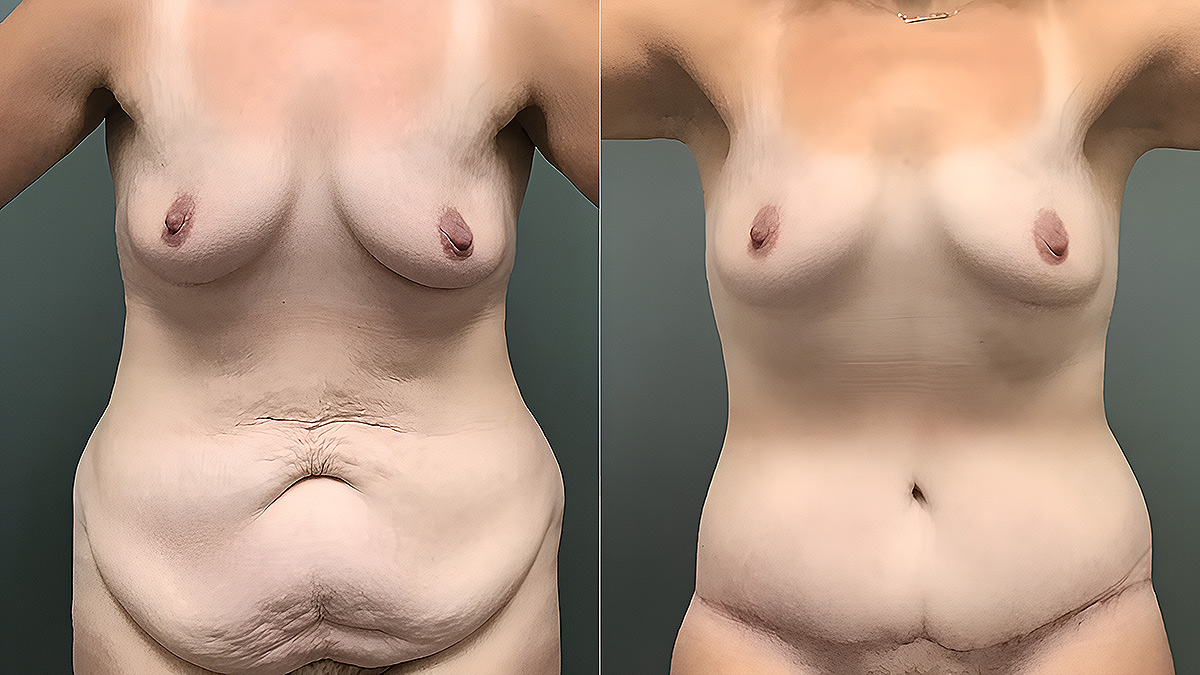
A standard abdominal tightening procedure creates a low horizontal scar designed to sit beneath underwear or swimwear.
Scar behavior varies by genetics. Some scars heal thin and pale. Some thicken or darken.
What improves scar outcome:
- tension control during closure
- keeping weight stable during healing
- silicone-based scar care once incisions are closed
- strict sun protection (important in San Antonio)
Scar maturation is slow. Expect the scar to change over 12 to 18 months.
The trade is simple:
The goal is to make that trade worth it.
Recovery: the repair needs protection
This recovery should be treated like a structural repair, because it is.
✓ The first week
Typical priorities:
- short, frequent walking starting early
- hydration and light meals
- consistent support garment use for comfort
- drain care when drains are used (common in many cases)
- rest with the torso supported and knees slightly bent to reduce pull on the lower abdomen
Why patients care: early walking reduces clot risk and stiffness. Rest protects the repair.
✓ Weeks 2–4
- walking increases
- lifting remains restricted
- core strain is avoided
- swelling gradually improves
Why patients care: overdoing it early is one of the most common reasons for setbacks.
✓ Around 6 weeks
Many patients begin a gradual return to normal daily activity with clearance. Heavier lifting may still be delayed depending on the repair and the patient’s healing.
✓ Around 3 months
The inner support layer has gained meaningful strength. A gradual return to more serious training becomes more reasonable.
✓ 6–12 months
Swelling continues to settle. Scars continue to mature. Contour looks more natural as tissue softens.
Both men and women often feel improved internal support early, but true strength and comfort build gradually.
Risks and how they are managed
All surgery carries risk. The goal is not to pretend otherwise. The goal is to manage risk with disciplined planning and follow-up.
Potential risks include:
- bleeding
- infection
- fluid collections (seroma)
- delayed wound healing
- numbness or altered sensation
- contour irregularity
- blood clots
- widened or thickened scars
Risk reduction includes:
- early, frequent walking
- structured follow-up
- careful tissue handling
- clear activity limits
- guidance on nutrition, hydration, and sleep
- planning surgery only when nicotine-free status and weight stability are in place
Patients should care about this because a “good surgery day” can still be followed by avoidable problems if recovery is not protected.
Long-term expectations
Results last best when:
- weight remains stable
- core habits continue
- major life changes are planned thoughtfully
For women, future pregnancy can stretch tissue. For men, major weight changes can affect contour.
The repair is durable, but it responds to the demands placed on it.
Frequently Asked Questions
What is diastasis recti?
Diastasis recti is widening of the midline support seam between the two rectus muscles. It is a stretching problem of the fascia, not a hole.
Is diastasis recti only a problem for women?
No. It is more common after pregnancy, but men can develop abdominal wall laxity, especially after significant weight gain and weight loss.
Is this the same as a hernia?
No. A hernia is a true defect or hole in the fascia. Diastasis is widening without a hole. Some patients have both, which changes planning.
Can exercise fix abdominal muscle separation?
Exercise improves strength and control, but it cannot reliably narrow stretched fascia once recoil has failed. It can improve function and comfort, but it may not change bulging or contour in a durable way.
What does surgery "tighten" if muscles are not cut?
The key tightening is done in the fascia, the strong internal layer that acts like a corset. When that layer is brought back together, core tension and contour often improve.
Will the belly button move?
In many full tightening procedures with skin removal, the belly button stays attached to the deeper layer while the skin is re-draped. The goal is a natural position and shape, not an obvious "new belly button."
Will liposuction alone fix a lower belly bulge?
Not if the bulge is coming from stretched fascia or loose skin. Liposuction can reduce thickness, but it does not tighten the support layer and it does not remove extra skin.
How long are lifting restrictions?
Many patients need strict lifting limits for about six weeks, sometimes longer depending on repair strength and healing. The repair needs time to gain strength before heavy strain is added back.
Will support feel better right away?
Many patients notice improved internal support early. That does not mean the repair is "fully healed." Healing and strengthening continue over months.
Can this surgery help back discomfort?
Some patients report improved posture support and less fatigue because the trunk feels more stable. Back pain has many causes, so it is not guaranteed, but improved core support can be meaningful for the right patient.
Will drains be used?
Drains are commonly used in many abdominal tightening surgeries, especially when skin is removed. They are temporary and are removed in the office when output is appropriate.
Will there be a scar?
Yes. A low horizontal scar is part of the tradeoff. Scar quality varies by genetics and aftercare. Silicone-based therapy and sun protection help.
What happens if weight changes after surgery?
Significant weight gain can stretch tissue again. Significant weight loss can create new looseness. Stable weight is one of the best predictors of long-term satisfaction.
Can this be combined with other procedures?
Sometimes, yes. Combining procedures must stay within safe time limits and recovery practicality. Staging is often the better plan when the total scope becomes too large.
Medical References
- Spitznagle TM, Leong FC, Van Dillen LR. Prevalence of diastasis recti abdominis in a urogynecological patient population. Int Urogynecol J Pelvic Floor Dysfunct. 2007.
- Mota P, Pascoal AG, Bø K. Diastasis recti abdominis in pregnancy and postpartum period: risk factors and association with lumbopelvic pain. Phys Ther. 2015.
- Benjamin DR, Frawley HC, Shields N, et al. Relationship between diastasis recti abdominis and musculoskeletal dysfunctions, pain, and quality of life: a systematic review. Phys Ther. 2019.
- Gluppe SL, Engh ME, Bø K. Immediate effect of abdominal and pelvic floor muscle exercises on inter-recti distance in postpartum women: a randomized controlled trial. Phys Ther. 2018.
- Sperstad JB, Tennfjord MK, Hilde G, Ellström-Engh M, Bø K. Diastasis recti abdominis during pregnancy and 12 months after childbirth: prevalence, risk factors, and report of lumbopelvic pain. Br J Sports Med. 2016.
- Hickey F, Finch JG, Khanna A. A systematic review on the outcomes of correction of diastasis of the recti. Hernia. 2011.
- Nahas FX. An aesthetic classification of the abdomen based on the myoaponeurotic layer. Plast Reconstr Surg. 2001.
- Nahas FX, et al. Long-term results of abdominal wall plication in abdominoplasty. Aesthetic Plast Surg. 2005.
- Venclauskas L, et al. Long-term follow-up after repair of rectus diastasis: functional and aesthetic outcomes. Hernia. 2017.
- van Uchelen JH, Werker PM, Kon M. The long-term durability of plication of the rectus sheath in abdominoplasty. Plast Reconstr Surg. 2001.
Closing
Abdominal wall separation and laxity can affect women after pregnancy and men after significant weight loss. When structure does not recover on its own, surgical tightening can restore support and contour in a way exercise and diet cannot.
This is not about chasing perfection. It is about restoring structure when the internal support layer has stretched beyond recoil.
A consultation in San Antonio should clarify:
- whether the main issue is fascia, skin, fat, or a combination
- what scar pattern matches real-life clothing choices
- how recovery should be structured for safety and long-term stability
- how timing should be planned around weight stability and life demands
All procedures carry risks. Individual results vary. Decisions are made case by case after examination and discussion of goals.
Further Reading
- Abdominoplasty (Tummy Tuck)
- Mommy Makeover
- Post–Weight Loss Body Contouring
- Liposuction
- Lower Body Lift
- Recovery After Fleur-De-Lis Surgery (FDL) - Tips and Timeline
- Returning to Exercise after Tummy Tuck