
What Really Helps, What Does Not, and How Dr. Baumholtz Plans for Better Healing
Most women who ask about a mommy makeover are not chasing perfection.
They are trying to feel normal again.
After pregnancy, the body can change in ways that do not fully reverse:
- The abdomen feels loose or hangs.
- The core feels weaker.
- The breasts sit lower or feel empty at the top.
- Clothes fit differently even at a stable weight.
A mommy makeover can address those changes.
But one concern almost every patient has is this:
That question deserves a real answer.
All surgery creates scars.
There is no such thing as scar-free surgery.
The goal is not to pretend scars will disappear.
The goal is to:
- Place scars where clothing hides them
- Close incisions in ways that reduce tension
- Protect blood supply
- Guide scars through a full year of healing
- Reduce widening, thickening, and darkening
Scar control is not cosmetic fluff.
It is part of surgical planning.
Video: Mommy Makeover Overview
What Is a Mommy Makeover?
A “mommy makeover” is not one single operation.
It is a custom combination of procedures that often includes:
- Abdominoplasty (tummy tuck) – removal of extra abdominal skin and tightening of the abdominal wall
- Breast lift (mastopexy) – raising and reshaping the breasts
- Breast augmentation – adding an implant for fullness
- Or a combination of lift + implant
- In some cases, breast reduction
- Selective liposuction in safe, separate areas
Every one of those procedures creates scars.
So the question is not “How do we avoid scars?”
The question is:
How do we create scars that heal quietly and mature well?
Where Mommy Makeover Scars Usually Are
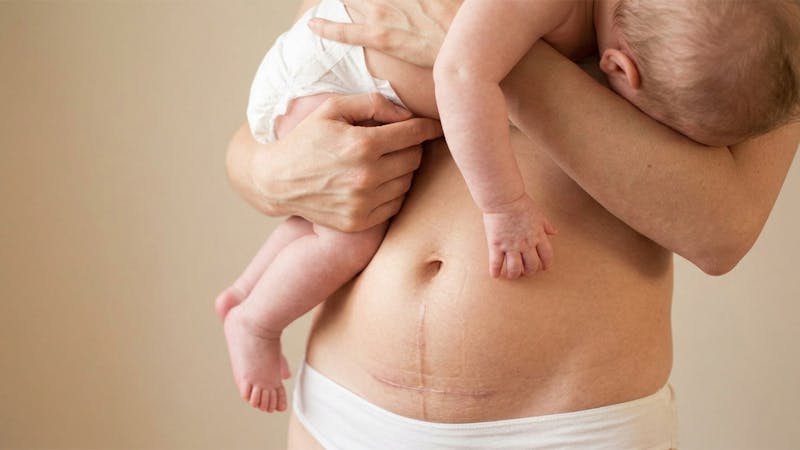
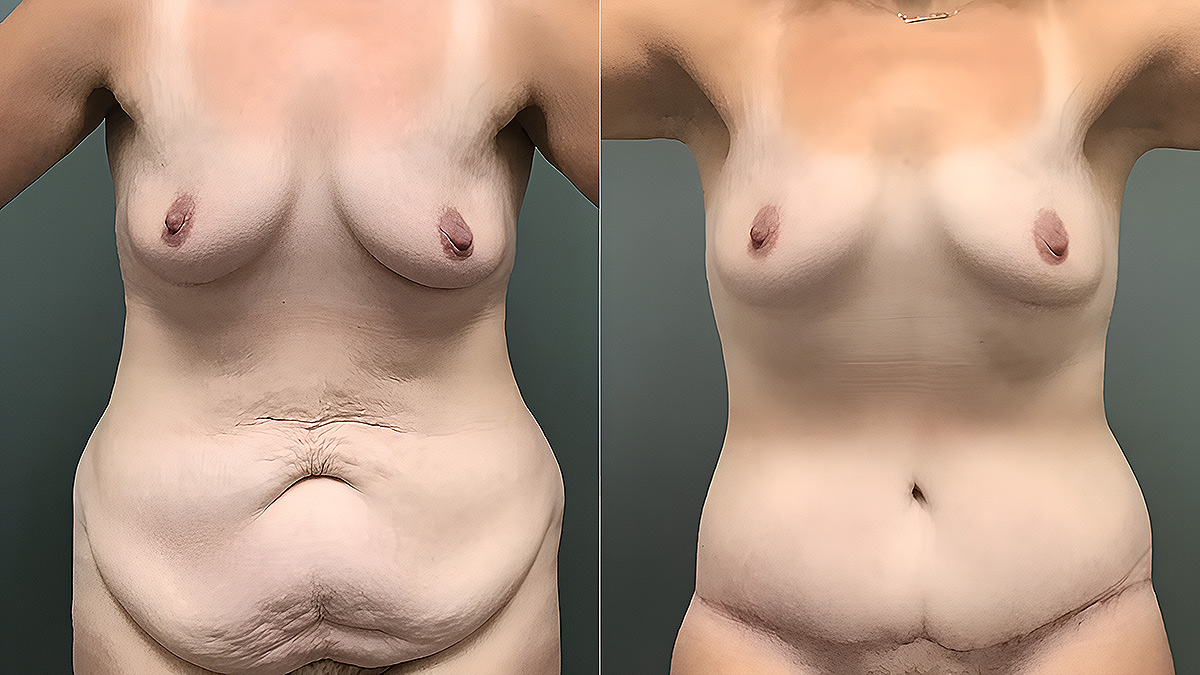
1. The Abdominal Scar
This is a low horizontal line.
It is designed to sit:
- Under underwear
- Under most swimwear
- In a natural curve
The length depends on how much extra skin must be removed.
Important truth:
A slightly longer scar placed low with low tension usually heals better than a short scar placed high under tight pull.
Trying to “save scar length” can create:
- Dog-ears (skin bunching at the ends)
- Higher scar position
- Widening over time
Scar placement matters more than scar length.
2. The Belly Button Scar
During a tummy tuck, the belly button is preserved and brought through a new opening in tightened skin.
Early on it may look:
- Tight
- Puffy
- Slightly uneven
Swelling improves over months.
3. Breast Scars
If implants only:
A small incision is often placed in the inframammary fold (the natural breast crease).
If a lift is needed:
Scar patterns depend on how much reshaping is required:
- Around the areola (mild lift)
- Around the areola + vertical line (moderate lift)
- Anchor pattern (more skin removal and stronger reshaping)
More lift usually means more scar.
But more lift often means better long-term shape.
4. Liposuction Access Points
These are small marks placed in:
- Natural creases
- Bikini lines
- Shadow zones
At Baumholtz Plastic Surgery, liposuction is never performed in the same zones where the abdominal skin is lifted.
If the abdomen is undermined and tightened, liposuction is not done on that flap.
If contouring is needed, it is performed in separate zones such as:
- Back
- Posterior waist
- Flanks
Why this matters:
Combining flap undermining and aggressive liposuction in the same area can compromise blood supply and increase wound and scar problems.
Protecting blood flow protects scars.
What “Minimizing Scars” Really Means
It does not mean removing scars.
It means improving:
✓ Scar Placement
Put scars where clothing hides them.
✓ Scar Quality
Aim for scars that are:
- Narrow
- Flat
- Soft
- Lightened over time
✓ Scar Behavior Over Time
Reduce widening, thickening, and darkening.
Why Scars Behave the Way They Do
Understanding scar biology helps reduce fear.
Three main forces control scar outcomes:
1. Blood Supply
Skin needs oxygen to heal well.
Nicotine reduces blood flow.
Nicotine includes:
- Cigarettes
- Vaping
- Nicotine gum
- Nicotine pouches
- Patches
Poor blood flow increases risk of:
- Delayed healing
- Wound separation
- Thick scars
Nicotine-free status is required before elective surgery.
2. Tension
Tension is one of the biggest drivers of wide scars.
High tension happens when:
- Skin is closed under strong pull
- Early heavy lifting strains the abdominal repair
- Tight waistbands rub and pull
- Core exercises are resumed too early
After muscle tightening, lifting restrictions are critical.
The internal repair needs time to gain strength.
3. Inflammation
Inflammation is part of healing.
Too much inflammation leads to:
- Persistent redness
- Raised scars
- Dark pigment
Common causes:
- Infection
- Friction
- UV exposure
- Early irritation
The Scar Timeline (What Is Normal)
Weeks 0–6
- Pink or red
- Firm
- Mild itching
- Slight unevenness
Months 2–6
Often looks worse before better.
This is normal.
The body is producing collagen quickly.
Months 6–12
- Softening
- Flattening
- Lightening
Key Principle:
Adult scars take about one year to mature.
Time is part of treatment.
Mommy Makeover Before and After Photos
Scar Management Standards at Baumholtz Plastic Surgery
Scar care is structured.
It includes:
✓ Strict UV Avoidance
Especially in San Antonio.
- Clothing coverage first
- Sunscreen once incisions are sealed
- Avoid tanning for a full year
UV can darken scars and make them stand out.
✓ Silicone Therapy
Silicone gel or silicone tape is started once incisions are fully sealed.
Silicone is one of the most studied scar treatments.
It helps:
- Flatten raised scars
- Reduce redness
- Improve softness
✓ Scar Massage
Started only after clearance.
Massage improves flexibility and softness.
Too early massage can worsen irritation.
✓ Microneedling (Selected Mature Scars)
Microneedling uses tiny needles to stimulate controlled collagen remodeling.
Early studies show promise for improving scar texture.
It is considered only after scars are fully healed and stable.
✓ Time
The most overlooked treatment.
Most scars change for 12–18 months.
Early judgment causes unnecessary anxiety.
Pre-Operative Steps That Improve Scar Outcomes
Better scars start before surgery.
- Nicotine-Free Period - Non-negotiable.
- Stable Weight - Weight swings stretch scars.
- Adequate Protein Intake - Healing requires building blocks.
- Avoid Crash Dieting
- Medication Review
- Avoid Pre-Op Tanning
- - Tanned skin holds pigment changes longer.
Recovery and Scar Protection
Week 1
- Rest
- Short walks
- Hydration
- Protect abdominal tension
- Manage drains if used
Posture may be slightly flexed to reduce pull.
Weeks 2–3
- Swelling improves
- Silicone begins once cleared
- Activity still limited
Weeks 3–6
Scars may look pinkest.
This is normal.
Weeks 6–12
Gradual return to exercise after clearance.
Core strengthening is resumed carefully.
When Scars Need Extra Help
Call the office if there is:
- Increasing redness
- Persistent thickening
- Widening
- Escalating itch
Options may include:
- Silicone taping adjustments
- Steroid injections
- Later scar revision after maturity
Common Scar Myths
Myth: Shorter scars are always better.
Reality: Low tension matters more than length.
Myth: Tanning hides scars.
Reality: UV darkens scars.
Myth: Oils replace proven care.
Reality: Silicone and UV avoidance have stronger evidence.
Frequently Asked Questions
Do scars disappear?
No. They mature and fade.
When can silicone start?
After incisions are sealed and cleared.
Does San Antonio sun matter?
Yes. UV can darken scars.
Can lifting too early widen scars?
Yes.
How long until scars settle?
About one year.
Is redness at 3 months normal?
Often, yes.
Can microneedling erase scars?
No. It may improve texture.
Does nicotine affect scars?
Yes, significantly.
Will my C-section scar be removed?
Often during tummy tuck skin excision.
When is scar revision done?
Usually after one year if needed.
PubMed References
- Gold MH et al. Updated international clinical recommendations on scar management. Dermatol Surg. 2014.
- O'Brien L, Pandit A. Silicone gel sheeting for hypertrophic scars. Cochrane Database Syst Rev. 2013.
- Atiyeh BS et al. Keloid or hypertrophic scar: controversy. Ann Plast Surg. 2005.
- Gauglitz GG et al. Hypertrophic scarring and keloids. Mol Med. 2011.
- Mustoe TA et al. International scar management recommendations. Plast Reconstr Surg. 2002.
- Ogawa R. Chronic inflammation in keloids. Int J Mol Sci. 2017.
- van der Wal MB et al. Scar assessment scales. J Burn Care Res. 2012.
- Berman B et al. Scar management review. J Clin Aesthet Dermatol. 2017.
- Durani P, McGrouther DA. Scar assessment review. J Plast Reconstr Aesthet Surg. 2009.
- Fabbrocini G et al. Microneedling in dermatology. Dermatol Ther. 2009.
Reasons to Choose Dr. Baumholtz for a Mommy Makeover
- Dual Board Certification in General Surgery and Plastic Surgery.
- Extensive experience in complex reconstruction and aesthetic revision cases.
- Conservative safety philosophy with strict operative boundaries.
- No liposuction on undermined abdominal flaps.
- Anatomy-first planning based on size, position, contour, and tissue quality.
- Structured scar management protocol with UV avoidance, silicone, massage, microneedling consideration, and emphasis on time.
- Direct accessibility through office, phone, and Symplast app.
- Experience managing prior scars and complex tissue behavior.
- Long-term follow-up across the full year of scar maturation.
- Clear explanation of tradeoffs before surgery.