
Losing weight is hard.
Keeping it off is harder.
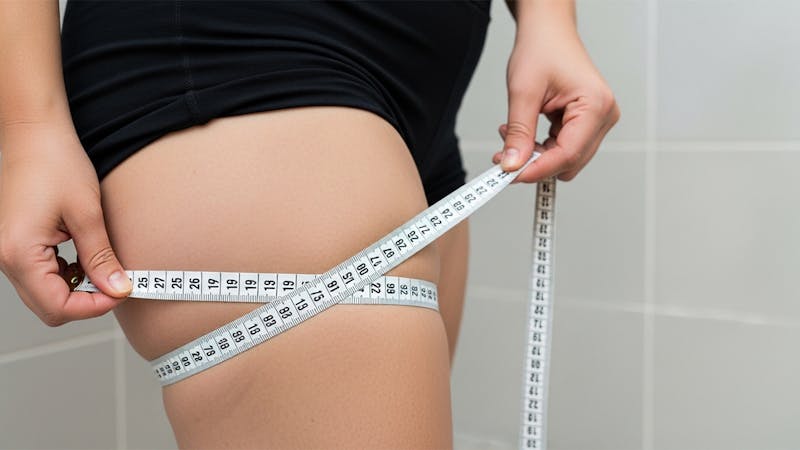
When the number on the scale finally drops and the mirror still shows loose thigh skin, it can feel unfair. Many men and women expect their thighs to tighten as their weight decreases. For many people, that does not happen.
The thighs may:
- Rub when walking
- Catch in leggings or jeans
- Hang or fold when sitting
- Feel out of proportion to the rest of the body
This page explains why loose thigh skin is common after weight loss - and what actually works to improve it. The tone here reflects how Dr. Michael Baumholtz speaks with patients in his San Antonio office: plain language, clear trade-offs, no exaggerated promises, and safety first.
The Short Answer
Loose thigh skin happens because stretched skin does not always shrink back.
Exercise improves muscle.
Diet improves health.
Neither removes extra skin.
When skin hangs, folds, rubs, or bunches, the only reliable way to remove it is surgery.
Other tools may help mildly loose skin look a little firmer. They do not erase true laxity.
The key is matching the treatment to the problem.
Why Thigh Skin Is So Stubborn After Weight Loss
Skin is living tissue. It stretches when the body grows. It tries to contract when the body shrinks.
That contraction depends on:
- Collagen (the structural protein that gives skin strength)
- Elastin (the protein that allows skin to recoil)
- Support tissues beneath the skin
When skin is stretched for a long time - or stretched significantly - those fibers lose strength.
Once that happens, the skin envelope does not fully recoil.
This is not a failure of effort.
It is biology.
Video: Inner Thigh Lift
Factors That Influence Loose Skin
1. Amount of Weight Loss
The more weight lost, the more likely loose skin becomes.
This applies to:
- Lifestyle-based weight loss
- Bariatric surgery
- GLP-1–assisted weight loss
Rapid loss gives skin less time to adapt.
2. Age
Younger skin typically has better recoil.
As we age:
- Collagen decreases
- Elastin fibers weaken
- Healing slows
Older patients often experience more visible laxity.
3. Genetics
Two people can lose the same amount of weight and look very different.
Genetic collagen quality plays a major role.
4. Location
The inner thigh is uniquely vulnerable.
Why?
- Skin is thinner
- Support tissue is delicate
- Motion is constant
- Friction is constant
- Gravity pulls downward
This combination explains why thighs often look looser than calves or arms.
Why Liposuction Alone Can Make It Worse
This is critical.
If the thigh skin is already loose and fat is removed aggressively:
The result can be an empty wrapper.
That means:
- More wrinkling
- More folds
- Worse creasing
Liposuction removes volume.
It does not remove skin.
In a lax thigh, removing fat without removing skin often exaggerates the problem.
Why Exercise and Creams Do Not Fix Loose Skin
Patients often say:
Because muscle lives underneath the skin.
Building quadriceps and adductors can actually make loose skin appear more obvious by creating a firmer base under a lax envelope.
As for creams and tightening devices:
- They may improve surface texture
- They may stimulate mild collagen production
- They do not remove folds or hanging skin
When skin drapes or rubs, surgery is the only option that changes anatomy.
Trying non-surgical tools first is reasonable.
Expecting them to erase excess skin is not.
How Dr. Baumholtz Evaluates Loose Thigh Skin
Evaluation begins with listening.
What bothers you most?
- Chafing and rashes?
- Clothing fit?
- Appearance in swimwear?
- Feeling unbalanced from hip to knee?
Daily life matters.
Someone who walks long distances or stands all day has different priorities than someone with primarily desk work.
Weight Stability Matters
Surgery works best when:
- Weight has been stable for at least 4–6 months
- Major weight swings are unlikely
- GLP-1 dosing has stabilized
Skin responds poorly to large post-operative weight changes.
The Physical Exam
Evaluation is done:
- Standing
- Walking
- Sitting
Pinch testing separates:
- True skin excess
- Residual fat
The goal is to avoid overcorrecting one area while under-treating another.
The Core Trade-Off: Folds for Scars
A thigh lift improves contour.
It requires scars.
That is the honest exchange.
The goal is to make that exchange worthwhile.
Scar placement is planned around:
- Clothing choices
- Swimwear habits
- Movement patterns
Dr. Baumholtz does not use VECTRA for body imaging. Careful measurements and markings are sufficient for predictable planning.
When Non-Surgical Care Is Enough
Non-surgical care is always encouraged:
- Weight stability
- Strength training
- Good nutrition
- Hydration
- Sun protection
In mild cases, these may be enough.
When skin:
- Hangs
- Folds
- Causes rashes
- Limits clothing
Non-surgical tools will not remove it.
Surgical Options for Loose Thigh Skin
Technique is matched to anatomy.
1. Short-Scar Inner Thigh Lift
Best for:
- Mild looseness
- Redundancy near the groin only
The incision sits in the groin crease.
Limitations:
- Does not reliably tighten mid-thigh
- Does not improve lower thigh
Using this for the wrong anatomy leads to disappointment.
2. Vertical (Medial) Thigh Lift
This is the workhorse procedure for significant inner thigh laxity.
Incisions include:
- Groin crease
- Vertical line along inner thigh
Benefits:
- Addresses laxity along the length of the thigh
- Removes substantial redundant skin
Trade-off:
- Longer scar
When the anatomy fits, contour improvement is meaningful.
3. Combined Approach
Used when:
- Skin redundancy runs both circumferentially and vertically
- Upper thigh and mid-thigh are both lax
Allows better redraping of tissue.
4. Extended or Spiral Concepts
For massive weight loss patients:
- Laxity may wrap into buttock or posterior thigh
- Often part of staged body contouring
Staging improves safety and mobility.
How a Thigh Lift Improves Shape
Skin removal changes geometry.
Instead of an empty envelope hanging over muscle:
The envelope becomes smaller and tighter.
Gentle liposuction may be added for blending - not bulk removal.
What a Thigh Lift Will Not Do
- Remove all cellulite
- Create perfectly smooth skin
- Create perfect symmetry
- Replace muscle tone
Cellulite results from fibrous bands tethering skin. Removing skin does not eliminate all dimpling.
Realistic expectations protect satisfaction.
Preparing for Surgery
Preparation lowers risk.
Requirements include:
- Nicotine cessation in all forms
- Medical optimization
- Medication review
- Stable weight
At home:
- Arrange help
- Prepare meals
- Plan time off
- Set up recovery space
Scars take 12–18 months to mature.
Swelling resolves in stages.
Patience is required.

Recovery Timeline
Day of Surgery
- Walking begins same day
- Legs elevated when resting
- Compression garment applied
Tightness when standing fully upright is common.
Weeks 2–3
- Swelling improves
- Mobility increases
- Many return to desk work
- Scar care begins once sealed
Weeks 4–6
- Gradual return to light lower body activity
- Tenderness fades
- Compression continues
3 Months and Beyond
- Most contour visible
- Swelling continues to soften
- Scars still maturing
Final scar appearance evolves over 12–18 months.
Risks and How They Are Managed
Risks include:
- Delayed wound healing
- Seroma
- Bleeding
- Infection
- Numbness
- Scar widening
The inner thigh is a high-movement zone. Minor wound delays are not uncommon.
Risk reduction includes:
- Strict nicotine avoidance
- Stable weight
- Gentle tissue handling
- Tension-balanced closure
- Accredited facility
- Board-certified anesthesia
Early communication prevents small issues from becoming larger ones.
Who Is a Good Candidate?
A good candidate:
- Has loose or hanging thigh skin
- Is at stable weight
- Is nicotine-free
- Understands scars are part of the exchange
- Has time and support to recover
Patients who should wait:
- Active nicotine users
- Unstable weight
- Uncontrolled medical conditions
Timing matters.
Expected Results
Most patients notice:
- Reduced friction
- Better clothing fit
- More balanced contour
- Slimmer appearance due to smaller skin envelope
Early swelling masks contour.
By 3 months, improvement is clear.
By 1 year, scars are mature.
Long-term results depend on weight stability.
Frequently Asked Questions
Can a thigh lift be combined with liposuction?
Yes, when fat and skin both contribute. Liposuction is conservative and used for blending.
Will the scars be visible?
Groin crease scars hide well. Vertical scars sit in inner thigh shadow. They fade but do not disappear.
Does insurance cover thigh lift?
Elective aesthetic thigh lifts are self-pay procedures.
How painful is recovery?
Tightness and soreness are common. Pain is managed with a multimodal plan.
How long until I can walk normally?
Light walking immediately. Most patients walk comfortably by 2–3 weeks.
Can cellulite be removed?
Cellulite improves modestly when excess skin is removed, but dimples often remain.
Will I need drains?
Sometimes. This depends on surgical extent.
What if I gain weight later?
Significant weight gain can stretch results.
Can thighs be done with tummy tuck?
Sometimes, but staging is often safer in large contour cases.
How long do scars take to fade?
Scars mature over 12–18 months.
Is non-surgical tightening effective?
Mild laxity may improve slightly. True excess skin does not disappear without surgery.
When can I exercise again?
Lower body exercise resumes gradually after clearance, usually 6–8 weeks.
Medical References
- Liquid Polycaprolactone (PCL) for Reversing PXE's Skin Laxity in Knees and Thighs - Clinical Case Reports - NIH PMC - https://pmc.ncbi.nlm.nih.gov/articles/PMC11845914/
- Injectable Poly-l-Lactic Acid for Body Aesthetic Treatments - NIH PMC - https://pmc.ncbi.nlm.nih.gov/articles/PMC11965205/
- A Comprehensive Review of Surgical Body Contouring Techniques for the Torso and Limbs - Cureus - NIH PMC - https://pmc.ncbi.nlm.nih.gov/articles/PMC12375336/
- Retrospective Review of Skin Laxity Improvement After a Single Acoustic Subcision Treatment - Dermatologic Surgery - NIH PMC - https://pmc.ncbi.nlm.nih.gov/articles/PMC12570603/
- Effectiveness of Body Remodeling and Cellulite Treatment Using Symmed RF Therapy - NIH PMC - https://pmc.ncbi.nlm.nih.gov/articles/PMC11735865/
- Near-circumferential Lower Body Lift: A Review of 40 Consecutive Cases - Annals of Plastic Surgery - NIH PMC - https://pmc.ncbi.nlm.nih.gov/articles/PMC7288879/
- A Systematic Review of Subsurface Radiofrequency Treatments for Skin Tightening - Plastic and Reconstructive Surgery Global Open - NIH PMC - https://pmc.ncbi.nlm.nih.gov/articles/PMC9415206/
Closing
Loose thigh skin after weight loss is common.
It is not a failure of discipline.
It is a consequence of stretched collagen and elastin.
When extra skin interferes with comfort or clothing, surgical removal is the option that changes anatomy.
If you are considering thigh lift surgery in San Antonio, schedule a consultation with Dr. Michael Baumholtz.
The goal is not perfection.
The goal is balanced contour, reduced friction, and a plan built around real life.
All procedures carry risks. Individual results vary. Decisions are made case by case after examination and discussion.
Further Reading
- Read more about Body Contouring
- Read more about Brazilian Butt Lift
- Read Dr Baumholtz's Blog on Managing And Minimizing Scars After A Spiral Thigh Lift
- Read Dr Baumholtz's Blog on What is Body Contouring: Benefits, Risks & Recovery
- Read Dr Baumholtz's Blog on Thigh Lift After Weight Loss In San Antonio, TX
- How To Remove Your Love Handles - Surgical Options for Fat Removal