
A clear, practical guide to timing a tummy tuck in San Antonio, TX
Why People Begin Thinking About Abdominoplasty
Most people considering a tummy tuck are not focused on a number on the scale.
They are reacting to what they see and feel in daily life.
Common concerns include:
- Loose lower abdominal skin that will not tighten
- A bulge in the lower abdomen despite exercise
- Clothing that fits poorly around the waist
- A core that feels weak or unsupported
- Skin that folds or hangs after weight loss
Many patients have already invested significant effort into improving their health. They may have changed their diet, started strength training, increased daily walking, or used medication-guided weight loss.
Yet the abdomen may still look or feel different than expected.
The question that follows is straightforward:
The correct answer depends on anatomy, safety, and whether the body is stable enough for surgery to produce durable results.
Video: Abdominoplasty AKA Tummy Tuck
Understanding Abdominal Anatomy
The front of the abdomen is made of several layers.
Understanding these layers helps explain what surgery can and cannot change.
✓ Skin
Skin is the outer covering of the body. It stretches during pregnancy and weight gain.
Sometimes it tightens again. Sometimes it does not.
Loose skin can create:
- folds
- overhang
- irritation
- difficulty fitting clothing
No exercise program can remove excess skin.
✓ Fat
Fat sits beneath the skin and also deeper inside the abdomen.
Two different types exist.
Subcutaneous fat
This sits between skin and muscle. It affects thickness and softness.
Visceral fat
This sits inside the abdomen around the organs.
Visceral fat pushes the abdomen outward and creates a rounded shape. Surgery cannot remove visceral fat.
✓ Fascia
Fascia is a strong connective tissue layer that sits over the abdominal muscles.
It functions like an internal corset.
When fascia stretches and does not recoil, the abdominal wall loses tension.
✓ Rectus Muscles
These are the paired muscles commonly called the “six-pack muscles.”
They run vertically from the ribs to the pelvis.
Between them is a midline seam of fascia.
When that seam widens, the muscles drift apart. This condition is called rectus diastasis, meaning separation of the rectus muscles.
Size vs Position vs Contour
Three separate factors determine how the abdomen looks.
✓ Size
How much tissue is present.
This includes fat and skin.
✓ Position
Where tissues sit on the body.
After pregnancy or weight loss, skin may hang lower than before.
✓ Contour
The smoothness and transitions between areas.
A flat abdomen depends on smooth contour between the waist, flanks, and lower abdomen.
Understanding these differences prevents unrealistic expectations.
What Abdominoplasty Actually Does
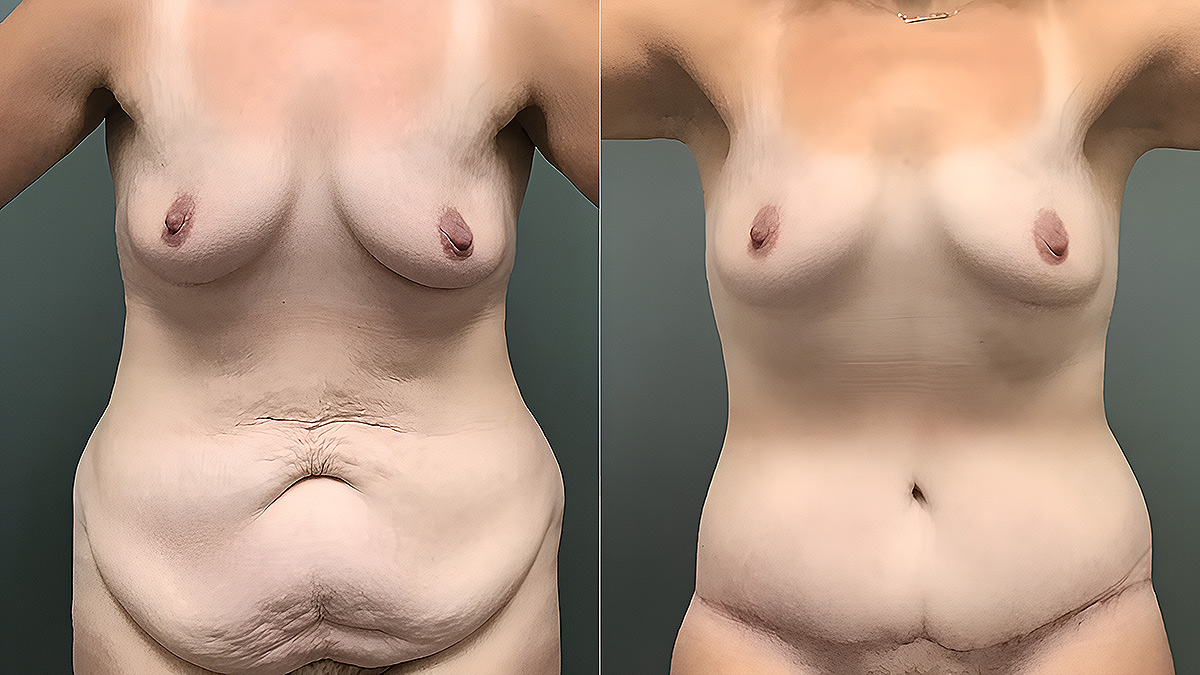
Abdominoplasty is a structural contour operation.
A properly planned procedure can:
- remove loose abdominal skin
- tighten the fascia when muscle separation is present
- improve lower abdominal contour
- improve waistline transitions
- support a flatter lower abdomen
Repairing rectus diastasis restores tension through the abdominal wall.
Many patients report that their core feels more supported after this repair.
What Abdominoplasty Does NOT Do
A tummy tuck does not:
- create meaningful weight loss
- remove visceral fat
- replace exercise or nutrition
- prevent future weight gain
- correct metabolic disease
Some tissue weight may be removed during surgery, but that is not the goal.
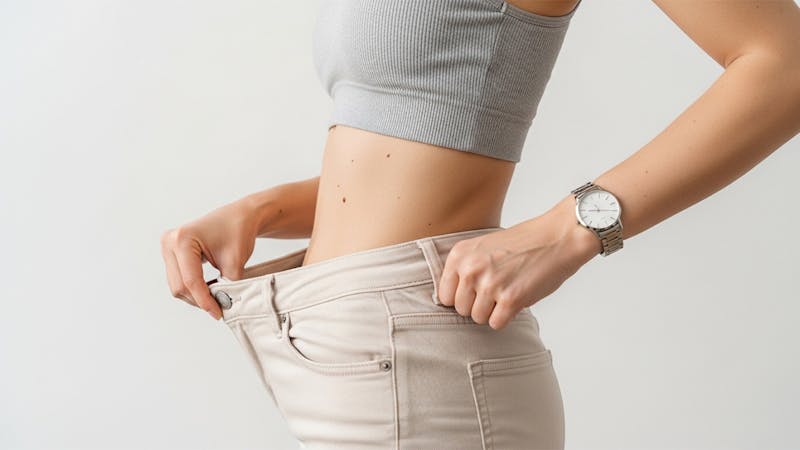
The goal is shape and support, not a lower number on the scale.
Why the Abdomen Changes
Several factors contribute to abdominal wall changes.
✓ Pregnancy
During pregnancy the abdominal wall stretches to accommodate a growing baby.
In many women the tissues tighten again. In others the fascia remains widened.
✓ Weight Gain and Weight Loss
When the body expands and then contracts, skin may not fully recoil.
Loose skin is common after significant weight loss.
✓ Aging
With time the elasticity of connective tissue decreases.
The abdominal wall can gradually lose tension.
✓ Genetics
Some individuals simply have stronger connective tissue recoil than others.
Who Is a Good Candidate
Patients often benefit from surgery when:
- weight has been stable for several months
- loose skin is the primary concern
- rectus diastasis is present
- medical conditions are controlled
- nicotine exposure has stopped
- recovery support is available at home
For men, common reasons include skin excess after major weight loss.
For women, pregnancy-related changes are common.
Surgery may be postponed when:
- weight is still decreasing significantly
- pregnancy is planned soon
- nicotine use continues
- medical conditions are uncontrolled
- expectations are unrealistic
Operating during rapid body change increases the chance that new loose skin may develop later.
Surgical Technique Overview
Each operation is individualized, but several principles guide the procedure.
These include:
- a low horizontal incision placed beneath clothing
- removal of excess lower abdominal skin
- repair of rectus diastasis when present
- reshaping of the waist and flanks when appropriate
- careful tissue handling to preserve blood supply
The belly button is typically preserved and repositioned naturally within the tightened skin envelope.
Scars
A tummy tuck creates a horizontal scar across the lower abdomen.
The scar is designed to sit below underwear or swimwear.
Scar appearance varies by genetics and healing response.
Scar maturation occurs gradually over 12 to 18 months.
Sun protection is important in Texas to reduce scar darkening.
Recovery Timeline
Recovery progresses in stages.
- Week 1
Walking begins immediately. Light movement reduces stiffness and clot risk.
Patients often walk slightly flexed at the waist initially to protect the incision.
- Weeks 2–4
Walking increases gradually.
Light daily tasks may resume depending on comfort.
- Around 6 Weeks
Many patients begin returning to normal activity levels.
Heavy lifting remains limited if muscle repair was performed.
- Around 3 Months
The fascial repair has gained significant strength.
Gradual return to exercise becomes possible with clearance.
- 6–12 Months
Swelling continues to resolve and scars continue to mature.
Final contour becomes more visible.
Risks and Complications
Potential complications include:
- bleeding
- infection
- fluid collections (seroma)
- delayed wound healing
- numbness
- contour irregularity
- blood clots
Careful planning, nicotine cessation, early walking, and structured follow-up reduce risk.
Long-Term Expectations
Results last best when:
- weight remains stable
- healthy habits continue
- major life changes are planned thoughtfully
Future pregnancy or significant weight change can stretch tissues again.
Frequently Asked Questions
How long should weight be stable before surgery?
Several months of stability is preferred.
Can exercise fix rectus diastasis?
Exercise improves strength but does not close a true separation.
Does a tummy tuck remove visceral fat?
No. Visceral fat responds to weight loss, not surgery.
Can men have abdominoplasty?
Yes. Common reasons include skin excess after weight loss.
How much weight is removed during surgery?
Usually modest amounts. The procedure improves contour rather than reducing weight.
Will scars be visible?
Scars are placed low on the abdomen and fade gradually.
Can liposuction be combined with abdominoplasty?
Yes, often for shaping of the flanks.
What happens if weight changes after surgery?
Significant weight gain or loss can affect results.
When can exercise resume?
Gradually after healing, often beginning around 6–12 weeks depending on muscle repair.
Will the abdomen feel tighter after surgery?
Many patients report improved core support following diastasis repair.
PubMed References
- Nahas FX. An aesthetic classification of the abdomen based on the myoaponeurotic layer. Plast Reconstr Surg.
- Hickey F, Finch JG. Outcomes of rectus diastasis correction. Hernia.
- Mota P, Pascoal AG. Diastasis recti in pregnancy and postpartum. Phys Ther.
- Spitznagle TM. Prevalence of diastasis recti in women. Int Urogynecol J.
- van Uchelen JH. Long-term durability of rectus sheath plication. Plast Reconstr Surg.
- Nahas FX. Long-term results of abdominal wall plication in abdominoplasty. Aesthetic Plast Surg.
- Sperstad JB. Prevalence of diastasis recti postpartum. Br J Sports Med.
Closing
A tummy tuck is not about reaching a perfect weight. It is about addressing structural changes that diet and exercise cannot correct.
For some patients, additional weight loss improves safety and results. For others with stable weight and persistent skin or muscle separation, surgery may be appropriate now.
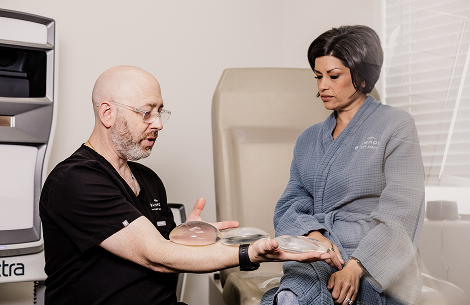
A consultation with Dr Baumholtz allows evaluation of anatomy, health status, and timing so that surgery is performed once, safely, and with durable results.